
What Healthcare Organizations Can Learn from the Boston Heart Diagnostics Settlement
- Jun 4
- 4 min read
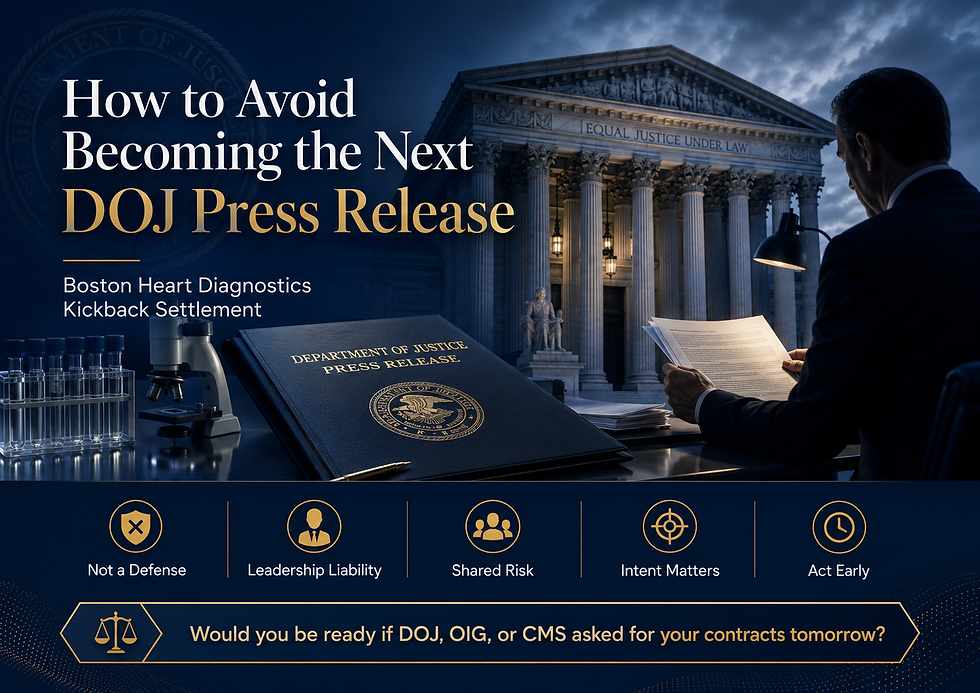
How to Avoid Becoming the Next DOJ Press Release: Lessons from the Boston Heart Diagnostics Kickback Settlement
Ask yourself: If CMS, OIG, or DOJ requested your contracts, compensation models, and referral data tomorrow, would you be ready?
On June 1, 2026, the Department of Justice announced another significant healthcare fraud settlement involving alleged violations of the Anti-Kickback Statute (AKS). The case resulted in more than $2 million in civil settlements involving a laboratory executive, sales leadership, marketers, and a physician.
While the settlement itself is noteworthy, the bigger lesson for laboratories, physician practices, healthcare executives, and marketers is this: The government continues to aggressively pursue arrangements that appear to disguise payments for referrals.
According to the DOJ, the parties allegedly used Managed Service Organizations (MSOs) as vehicles to funnel payments to physicians in exchange for laboratory referrals. The government alleged that these payments were disguised as investment distributions while functioning as illegal kickbacks.
Even more concerning, the DOJ alleged that leadership received warnings about the arrangement and proceeded anyway.
For healthcare organizations, this case serves as a powerful reminder that compliance failures rarely happen overnight. They develop through a series of decisions, ignored warning signs, and inadequate oversight.
Five Compliance Lessons Every Healthcare Organization Should Take Seriously
1. If Revenue Depends on Referrals, Scrutinize Every Financial Relationship
One of the most common misconceptions in healthcare is that a payment arrangement becomes compliant simply because it has a contract attached to it.
It does not.
The question regulators ask is: "What is the true purpose of the payment?"
If compensation increases as referrals increase, regulators may view the arrangement as remuneration intended to induce referrals.
Organizations should regularly review:
MSO agreements
Marketing agreements
Medical director contracts
Consulting arrangements
Investment opportunities involving referral sources
Revenue-sharing models
If the arrangement cannot withstand regulatory scrutiny, it likely should not exist.
2. Compliance Concerns Must Be Escalated and Acted Upon
One of the most striking allegations in this case was that leadership allegedly received warnings and recommendations to discontinue certain activities.
The DOJ specifically referenced concerns regarding hospital arrangements in Texas and allegations that leadership expanded the model despite those warnings.
This highlights a critical compliance principle: Identifying a risk is not enough.
Organizations must demonstrate:
Documentation of concerns
Investigation of allegations
Corrective action plans
Executive oversight
Board-level reporting when appropriate
If concerns are raised but ignored, the documentation can become evidence against the organization.
3. Sales and Marketing Teams Require Active Compliance Oversight
Many healthcare organizations invest heavily in compliance training for clinicians and billing staff while overlooking sales and marketing personnel.
That is a mistake.
Sales representatives are often on the front lines interacting with referral sources and discussing financial arrangements.
Every organization should ensure:
Annual AKS training for sales teams
Written marketing policies
Monitoring of compensation structures
Documentation of interactions with referral sources
Compliance review of marketing initiatives before implementation
A high-performing sales team can become a high-risk sales team without proper oversight.
4. Physicians Are Not Immune from Liability
This case reinforces an important reality: Physicians can face both civil and criminal exposure when participating in arrangements that involve referral-based compensation.
The government has increasingly focused on individual accountability.
Physicians should carefully evaluate:
Ownership opportunities
MSO participation
Medical directorships
Consulting agreements
Speaker programs
Referral-related compensation arrangements
The question should never be: "How much can I earn?"
The question should be:"Can I clearly demonstrate a legitimate business purpose independent of referrals?"
5. Build a Compliance Program Before You Need One
Perhaps the most important lesson is that a strong compliance program is significantly less expensive than defending a government investigation.
Organizations should routinely:
Conduct Anti-Kickback Statute risk assessments
Review financial relationships with referral sources
Audit laboratory ordering patterns
Monitor medical necessity
Evaluate compensation arrangements
Train leadership on personal liability risks
Maintain effective reporting and investigation processes
The Office of Inspector General has repeatedly emphasized that compliance programs should be operational, not theoretical.
A policy sitting on a shelf will not protect an organization during an investigation.
The Bottom Line
This enforcement action is not simply about laboratories or MSOs.
It is about intent.
The government continues to focus on arrangements that appear to place financial incentives ahead of independent clinical judgment.
Whether you are a laboratory executive, physician owner, compliance officer, marketer, or healthcare administrator, now is the time to ask: If the DOJ reviewed our financial relationships tomorrow, could we clearly demonstrate that every arrangement serves a legitimate business purpose and is not tied to referrals?
If the answer is uncertain, it may be time for a proactive compliance review.
The cost of prevention is almost always less than the cost of becoming the next enforcement headline.
ProCode Compliance Perspective
Many organizations believe they are protected because they have contracts, legal opinions, or longstanding arrangements. Enforcement actions like this demonstrate that regulators look beyond the paperwork and focus on the substance of the relationship.
A proactive Anti-Kickback Statute risk assessment can identify vulnerabilities before they become government investigations, whistleblower complaints, repayment demands, or False Claims Act litigation.
Ask yourself: If CMS, OIG, or DOJ requested your contracts, compensation models, and referral data tomorrow, would you be ready?


.png)